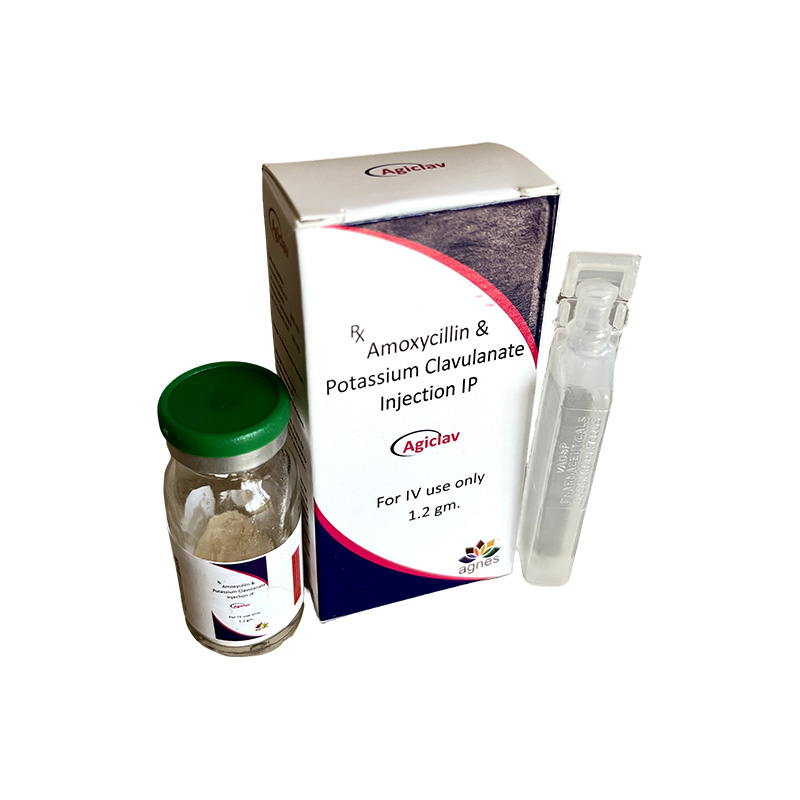
AGICLAV
COMPOSITION
Amoxycillin Sodium 1000mg + Clavulanic Acid 200mg (Injection)
Category
Beta-lactam antibiotic (Penicillin group) with beta-lactamase inhibitor.
| Packing |
|---|
SKU
2bf5301cc3fa
Categories AGNES, INJECTABLES, Injection
ENQUIRY
Indications
AGICLAV is clinically indicated for the treatment of severe infections caused by susceptible organisms in several anatomical regions:
Respiratory Tract Infections (RTIs): Highly effective for severe community-acquired pneumonia, acute exacerbations of chronic bronchitis, and complicated sinusitis.
Urinary Tract Infections (UTIs): Indicated for complicated cystitis, pyelonephritis (kidney infection), and recurrent infections of the urinary system.
Skin and Soft Tissue Infections: Management of deep-seated cellulitis, infected animal bites, and severe dental abscesses with spreading cellulitis.
Bone and Joint Infections: Used as a primary therapeutic agent for osteomyelitis and septic arthritis requiring intravenous intervention.
Intra-abdominal Infections: Treatment of peritonitis, post-surgical abdominal sepsis, and complicated cholecystitis.
Gynecological Infections: Management of pelvic inflammatory disease (PID), puerperal sepsis, and post-abortal infections.
Prophylaxis: Indicated for the prevention of infection in major surgical procedures, especially those involving the gastrointestinal tract, pelvic cavity, or head and neck.
Respiratory Tract Infections (RTIs): Highly effective for severe community-acquired pneumonia, acute exacerbations of chronic bronchitis, and complicated sinusitis.
Urinary Tract Infections (UTIs): Indicated for complicated cystitis, pyelonephritis (kidney infection), and recurrent infections of the urinary system.
Skin and Soft Tissue Infections: Management of deep-seated cellulitis, infected animal bites, and severe dental abscesses with spreading cellulitis.
Bone and Joint Infections: Used as a primary therapeutic agent for osteomyelitis and septic arthritis requiring intravenous intervention.
Intra-abdominal Infections: Treatment of peritonitis, post-surgical abdominal sepsis, and complicated cholecystitis.
Gynecological Infections: Management of pelvic inflammatory disease (PID), puerperal sepsis, and post-abortal infections.
Prophylaxis: Indicated for the prevention of infection in major surgical procedures, especially those involving the gastrointestinal tract, pelvic cavity, or head and neck.
Uses
The clinical utility of AGICLAV centers on its ability to overcome bacterial resistance and provide rapid bactericidal action:
Treats Severe Bacterial Infections: As an injectable, it provides 100% bioavailability, making it the choice for patients who cannot tolerate oral medication or those with life-threatening systemic infections.
Used in RTIs, UTIs, and Intra-abdominal Infections: It offers comprehensive empirical coverage while waiting for culture and sensitivity results, targeting the most common pathogens in these regions.
Effective Against Resistant Strains: The addition of Potassium Clavulanate extends the spectrum of Amoxycillin to include many bacteria that produce beta-lactamase, the enzyme responsible for penicillin resistance.
Covers Gram-Positive and Gram-Negative Bacteria: It provides a “wide-net” therapeutic approach, treating everything from Streptococcus species to E. coli and Haemophilus influenzae.
Used in Bone and Joint Infections: Its high tissue penetration allows the antibiotic to reach therapeutic levels within the bone matrix and synovial fluid.
Eradicates Beta-Lactamase Producing Pathogens: Specifically targets Staphylococci and Bacteroides species that often cause treatment failure with standard antibiotics.
Facilitates Sequential Therapy: Often used as the initial intravenous “kick-start” before transitioning the patient to oral AGICLAV tablets for home recovery.
Treats Severe Bacterial Infections: As an injectable, it provides 100% bioavailability, making it the choice for patients who cannot tolerate oral medication or those with life-threatening systemic infections.
Used in RTIs, UTIs, and Intra-abdominal Infections: It offers comprehensive empirical coverage while waiting for culture and sensitivity results, targeting the most common pathogens in these regions.
Effective Against Resistant Strains: The addition of Potassium Clavulanate extends the spectrum of Amoxycillin to include many bacteria that produce beta-lactamase, the enzyme responsible for penicillin resistance.
Covers Gram-Positive and Gram-Negative Bacteria: It provides a “wide-net” therapeutic approach, treating everything from Streptococcus species to E. coli and Haemophilus influenzae.
Used in Bone and Joint Infections: Its high tissue penetration allows the antibiotic to reach therapeutic levels within the bone matrix and synovial fluid.
Eradicates Beta-Lactamase Producing Pathogens: Specifically targets Staphylococci and Bacteroides species that often cause treatment failure with standard antibiotics.
Facilitates Sequential Therapy: Often used as the initial intravenous “kick-start” before transitioning the patient to oral AGICLAV tablets for home recovery.
Dosage & Storage
Strict adherence to pharmacological guidelines ensures the optimal biological activity of the antimicrobial components:
Individualized Dosing: The exact dose is strictly determined by the severity of the infection, the patient’s age, body weight, and renal function.
Typical Adult Dose: For severe infections, the standard dose is 1.2 gm every 8 hours, administered via slow intravenous injection or infusion.
Storage Temperature: Store the dry powder vial in a cool, dry place below 25°C.
Environmental Protection: Keep the medication protected from moisture and direct light to prevent the degradation of the Clavulanic Acid component.
Reconstitution Stability: Once the powder is mixed with the diluent, the solution must be used immediately (usually within 20 minutes) as it is not stable for long periods.
Safety: Keep the injection and all associated medical supplies out of the sight and reach of children and unauthorized personnel.
Individualized Dosing: The exact dose is strictly determined by the severity of the infection, the patient’s age, body weight, and renal function.
Typical Adult Dose: For severe infections, the standard dose is 1.2 gm every 8 hours, administered via slow intravenous injection or infusion.
Storage Temperature: Store the dry powder vial in a cool, dry place below 25°C.
Environmental Protection: Keep the medication protected from moisture and direct light to prevent the degradation of the Clavulanic Acid component.
Reconstitution Stability: Once the powder is mixed with the diluent, the solution must be used immediately (usually within 20 minutes) as it is not stable for long periods.
Safety: Keep the injection and all associated medical supplies out of the sight and reach of children and unauthorized personnel.
Directions For Use
As a potent injectable medication, AGICLAV must be handled with strict clinical precision:
Professional Administration Only: Your physician or trained nursing staff will administer this injection. Please do not self-administer.
Reconstitution Process: Before use, the vial must be reconstituted with the recommended sterile diluent (typically Water for Injection or 0.9% Normal Saline).
Aseptic Technique: Ensure proper aseptic techniques are maintained during the entire preparation and injection process to prevent secondary contamination.
Visual Verification: The reconstituted solution should be clear and pale straw-colored. If the solution is cloudy or contains visible particles, it must be discarded.
Slow Administration: When given as a bolus injection, it should be administered slowly over 3 to 4 minutes to minimize the risk of vein irritation (phlebitis).
Infusion Option: For longer delivery, it may be added to an intravenous drip and infused over 30 to 40 minutes.
Professional Administration Only: Your physician or trained nursing staff will administer this injection. Please do not self-administer.
Reconstitution Process: Before use, the vial must be reconstituted with the recommended sterile diluent (typically Water for Injection or 0.9% Normal Saline).
Aseptic Technique: Ensure proper aseptic techniques are maintained during the entire preparation and injection process to prevent secondary contamination.
Visual Verification: The reconstituted solution should be clear and pale straw-colored. If the solution is cloudy or contains visible particles, it must be discarded.
Slow Administration: When given as a bolus injection, it should be administered slowly over 3 to 4 minutes to minimize the risk of vein irritation (phlebitis).
Infusion Option: For longer delivery, it may be added to an intravenous drip and infused over 30 to 40 minutes.
Precautions
Patients and clinicians must observe the following medical safeguards to ensure a safe treatment course:
Hypersensitivity Screening: Absolute contraindication in patients with a known history of hypersensitivity to penicillins, cephalosporins, or other beta-lactam antibiotics.
Renal Impairment: Use with caution and reduced dosage frequency in patients with significant kidney dysfunction, as the drug is primarily excreted through the urine.
Liver Dysfunction: Monitor liver function tests closely, especially during prolonged therapy, as cholestatic jaundice has been reported in rare cases.
Pregnancy and Lactation: While generally considered safe, it should only be used during pregnancy and breastfeeding if the clinical necessity is clearly established by a doctor.
Allergic Reaction Monitoring: Healthcare providers must monitor for signs of anaphylaxis or severe skin reactions (like Stevens-Johnson syndrome) during the initial administration.
Mononucleosis: Avoid use in patients suspected of having glandular fever (infectious mononucleosis), as it significantly increases the risk of a non-allergic skin rash.
Gastrointestinal Health: Prolonged use may lead to an overgrowth of non-susceptible organisms like C. difficile. Inform your doctor if severe, watery diarrhea develops.
Hypersensitivity Screening: Absolute contraindication in patients with a known history of hypersensitivity to penicillins, cephalosporins, or other beta-lactam antibiotics.
Renal Impairment: Use with caution and reduced dosage frequency in patients with significant kidney dysfunction, as the drug is primarily excreted through the urine.
Liver Dysfunction: Monitor liver function tests closely, especially during prolonged therapy, as cholestatic jaundice has been reported in rare cases.
Pregnancy and Lactation: While generally considered safe, it should only be used during pregnancy and breastfeeding if the clinical necessity is clearly established by a doctor.
Allergic Reaction Monitoring: Healthcare providers must monitor for signs of anaphylaxis or severe skin reactions (like Stevens-Johnson syndrome) during the initial administration.
Mononucleosis: Avoid use in patients suspected of having glandular fever (infectious mononucleosis), as it significantly increases the risk of a non-allergic skin rash.
Gastrointestinal Health: Prolonged use may lead to an overgrowth of non-susceptible organisms like C. difficile. Inform your doctor if severe, watery diarrhea develops.
Side Effects
Diarrhea
Rash
Nausea
Hypersensitivity Reactions
Local Site Inflammation
Rash
Nausea
Hypersensitivity Reactions
Local Site Inflammation
Medical Disclaimer
The information provided is for educational and informational purposes only and is not intended as medical advice.
Always consult a healthcare professional for medical advice, diagnosis, or treatment.
Agnes Life Sciences does not claim that any of its products can diagnose, treat, cure, or prevent any disease.
This medication is a prescription-only injectable and must only be administered by a licensed medical practitioner.
Always consult a healthcare professional for medical advice, diagnosis, or treatment.
Agnes Life Sciences does not claim that any of its products can diagnose, treat, cure, or prevent any disease.
This medication is a prescription-only injectable and must only be administered by a licensed medical practitioner.
Indications
AGICLAV is clinically indicated for the treatment of severe infections caused by susceptible organisms in several anatomical regions:
Respiratory Tract Infections (RTIs): Highly effective for severe community-acquired pneumonia, acute exacerbations of chronic bronchitis, and complicated sinusitis.
Urinary Tract Infections (UTIs): Indicated for complicated cystitis, pyelonephritis (kidney infection), and recurrent infections of the urinary system.
Skin and Soft Tissue Infections: Management of deep-seated cellulitis, infected animal bites, and severe dental abscesses with spreading cellulitis.
Bone and Joint Infections: Used as a primary therapeutic agent for osteomyelitis and septic arthritis requiring intravenous intervention.
Intra-abdominal Infections: Treatment of peritonitis, post-surgical abdominal sepsis, and complicated cholecystitis.
Gynecological Infections: Management of pelvic inflammatory disease (PID), puerperal sepsis, and post-abortal infections.
Prophylaxis: Indicated for the prevention of infection in major surgical procedures, especially those involving the gastrointestinal tract, pelvic cavity, or head and neck.
Respiratory Tract Infections (RTIs): Highly effective for severe community-acquired pneumonia, acute exacerbations of chronic bronchitis, and complicated sinusitis.
Urinary Tract Infections (UTIs): Indicated for complicated cystitis, pyelonephritis (kidney infection), and recurrent infections of the urinary system.
Skin and Soft Tissue Infections: Management of deep-seated cellulitis, infected animal bites, and severe dental abscesses with spreading cellulitis.
Bone and Joint Infections: Used as a primary therapeutic agent for osteomyelitis and septic arthritis requiring intravenous intervention.
Intra-abdominal Infections: Treatment of peritonitis, post-surgical abdominal sepsis, and complicated cholecystitis.
Gynecological Infections: Management of pelvic inflammatory disease (PID), puerperal sepsis, and post-abortal infections.
Prophylaxis: Indicated for the prevention of infection in major surgical procedures, especially those involving the gastrointestinal tract, pelvic cavity, or head and neck.
Uses
The clinical utility of AGICLAV centers on its ability to overcome bacterial resistance and provide rapid bactericidal action:
Treats Severe Bacterial Infections: As an injectable, it provides 100% bioavailability, making it the choice for patients who cannot tolerate oral medication or those with life-threatening systemic infections.
Used in RTIs, UTIs, and Intra-abdominal Infections: It offers comprehensive empirical coverage while waiting for culture and sensitivity results, targeting the most common pathogens in these regions.
Effective Against Resistant Strains: The addition of Potassium Clavulanate extends the spectrum of Amoxycillin to include many bacteria that produce beta-lactamase, the enzyme responsible for penicillin resistance.
Covers Gram-Positive and Gram-Negative Bacteria: It provides a “wide-net” therapeutic approach, treating everything from Streptococcus species to E. coli and Haemophilus influenzae.
Used in Bone and Joint Infections: Its high tissue penetration allows the antibiotic to reach therapeutic levels within the bone matrix and synovial fluid.
Eradicates Beta-Lactamase Producing Pathogens: Specifically targets Staphylococci and Bacteroides species that often cause treatment failure with standard antibiotics.
Facilitates Sequential Therapy: Often used as the initial intravenous “kick-start” before transitioning the patient to oral AGICLAV tablets for home recovery.
Treats Severe Bacterial Infections: As an injectable, it provides 100% bioavailability, making it the choice for patients who cannot tolerate oral medication or those with life-threatening systemic infections.
Used in RTIs, UTIs, and Intra-abdominal Infections: It offers comprehensive empirical coverage while waiting for culture and sensitivity results, targeting the most common pathogens in these regions.
Effective Against Resistant Strains: The addition of Potassium Clavulanate extends the spectrum of Amoxycillin to include many bacteria that produce beta-lactamase, the enzyme responsible for penicillin resistance.
Covers Gram-Positive and Gram-Negative Bacteria: It provides a “wide-net” therapeutic approach, treating everything from Streptococcus species to E. coli and Haemophilus influenzae.
Used in Bone and Joint Infections: Its high tissue penetration allows the antibiotic to reach therapeutic levels within the bone matrix and synovial fluid.
Eradicates Beta-Lactamase Producing Pathogens: Specifically targets Staphylococci and Bacteroides species that often cause treatment failure with standard antibiotics.
Facilitates Sequential Therapy: Often used as the initial intravenous “kick-start” before transitioning the patient to oral AGICLAV tablets for home recovery.
Dosage & Storage
Strict adherence to pharmacological guidelines ensures the optimal biological activity of the antimicrobial components:
Individualized Dosing: The exact dose is strictly determined by the severity of the infection, the patient’s age, body weight, and renal function.
Typical Adult Dose: For severe infections, the standard dose is 1.2 gm every 8 hours, administered via slow intravenous injection or infusion.
Storage Temperature: Store the dry powder vial in a cool, dry place below 25°C.
Environmental Protection: Keep the medication protected from moisture and direct light to prevent the degradation of the Clavulanic Acid component.
Reconstitution Stability: Once the powder is mixed with the diluent, the solution must be used immediately (usually within 20 minutes) as it is not stable for long periods.
Safety: Keep the injection and all associated medical supplies out of the sight and reach of children and unauthorized personnel.
Individualized Dosing: The exact dose is strictly determined by the severity of the infection, the patient’s age, body weight, and renal function.
Typical Adult Dose: For severe infections, the standard dose is 1.2 gm every 8 hours, administered via slow intravenous injection or infusion.
Storage Temperature: Store the dry powder vial in a cool, dry place below 25°C.
Environmental Protection: Keep the medication protected from moisture and direct light to prevent the degradation of the Clavulanic Acid component.
Reconstitution Stability: Once the powder is mixed with the diluent, the solution must be used immediately (usually within 20 minutes) as it is not stable for long periods.
Safety: Keep the injection and all associated medical supplies out of the sight and reach of children and unauthorized personnel.
Directions For Use
As a potent injectable medication, AGICLAV must be handled with strict clinical precision:
Professional Administration Only: Your physician or trained nursing staff will administer this injection. Please do not self-administer.
Reconstitution Process: Before use, the vial must be reconstituted with the recommended sterile diluent (typically Water for Injection or 0.9% Normal Saline).
Aseptic Technique: Ensure proper aseptic techniques are maintained during the entire preparation and injection process to prevent secondary contamination.
Visual Verification: The reconstituted solution should be clear and pale straw-colored. If the solution is cloudy or contains visible particles, it must be discarded.
Slow Administration: When given as a bolus injection, it should be administered slowly over 3 to 4 minutes to minimize the risk of vein irritation (phlebitis).
Infusion Option: For longer delivery, it may be added to an intravenous drip and infused over 30 to 40 minutes.
Professional Administration Only: Your physician or trained nursing staff will administer this injection. Please do not self-administer.
Reconstitution Process: Before use, the vial must be reconstituted with the recommended sterile diluent (typically Water for Injection or 0.9% Normal Saline).
Aseptic Technique: Ensure proper aseptic techniques are maintained during the entire preparation and injection process to prevent secondary contamination.
Visual Verification: The reconstituted solution should be clear and pale straw-colored. If the solution is cloudy or contains visible particles, it must be discarded.
Slow Administration: When given as a bolus injection, it should be administered slowly over 3 to 4 minutes to minimize the risk of vein irritation (phlebitis).
Infusion Option: For longer delivery, it may be added to an intravenous drip and infused over 30 to 40 minutes.
Precautions
Patients and clinicians must observe the following medical safeguards to ensure a safe treatment course:
Hypersensitivity Screening: Absolute contraindication in patients with a known history of hypersensitivity to penicillins, cephalosporins, or other beta-lactam antibiotics.
Renal Impairment: Use with caution and reduced dosage frequency in patients with significant kidney dysfunction, as the drug is primarily excreted through the urine.
Liver Dysfunction: Monitor liver function tests closely, especially during prolonged therapy, as cholestatic jaundice has been reported in rare cases.
Pregnancy and Lactation: While generally considered safe, it should only be used during pregnancy and breastfeeding if the clinical necessity is clearly established by a doctor.
Allergic Reaction Monitoring: Healthcare providers must monitor for signs of anaphylaxis or severe skin reactions (like Stevens-Johnson syndrome) during the initial administration.
Mononucleosis: Avoid use in patients suspected of having glandular fever (infectious mononucleosis), as it significantly increases the risk of a non-allergic skin rash.
Gastrointestinal Health: Prolonged use may lead to an overgrowth of non-susceptible organisms like C. difficile. Inform your doctor if severe, watery diarrhea develops.
Hypersensitivity Screening: Absolute contraindication in patients with a known history of hypersensitivity to penicillins, cephalosporins, or other beta-lactam antibiotics.
Renal Impairment: Use with caution and reduced dosage frequency in patients with significant kidney dysfunction, as the drug is primarily excreted through the urine.
Liver Dysfunction: Monitor liver function tests closely, especially during prolonged therapy, as cholestatic jaundice has been reported in rare cases.
Pregnancy and Lactation: While generally considered safe, it should only be used during pregnancy and breastfeeding if the clinical necessity is clearly established by a doctor.
Allergic Reaction Monitoring: Healthcare providers must monitor for signs of anaphylaxis or severe skin reactions (like Stevens-Johnson syndrome) during the initial administration.
Mononucleosis: Avoid use in patients suspected of having glandular fever (infectious mononucleosis), as it significantly increases the risk of a non-allergic skin rash.
Gastrointestinal Health: Prolonged use may lead to an overgrowth of non-susceptible organisms like C. difficile. Inform your doctor if severe, watery diarrhea develops.
Side Effects
Diarrhea
Rash
Nausea
Hypersensitivity Reactions
Local Site Inflammation
Rash
Nausea
Hypersensitivity Reactions
Local Site Inflammation
Medical Disclaimer
The information provided is for educational and informational purposes only and is not intended as medical advice.
Always consult a healthcare professional for medical advice, diagnosis, or treatment.
Agnes Life Sciences does not claim that any of its products can diagnose, treat, cure, or prevent any disease.
This medication is a prescription-only injectable and must only be administered by a licensed medical practitioner.
Always consult a healthcare professional for medical advice, diagnosis, or treatment.
Agnes Life Sciences does not claim that any of its products can diagnose, treat, cure, or prevent any disease.
This medication is a prescription-only injectable and must only be administered by a licensed medical practitioner.